
Even Prime Minister Narendra Modi told US Vice President JD Vance on May 9 that Indian response will be "more forceful, stronger, devastating" in response to Pakistani actions, the sources said.
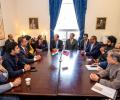
The lawmakers also hailed the strong strategic partnership between India and the US during a meeting with an all-party delegation led by Congress MP Shashi Tharoor, who briefed them on the cross-border terrorism faced by India and the country's strong and resolute stance in the fight against terror.
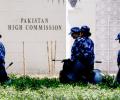
Pakistan has expressed condolences over the deaths of tourists in a terror attack in Pahalgam, Jammu and Kashmir, that killed 26 people. The Foreign Office spokesperson said Pakistan is concerned at the loss of tourists' lives and wished the injured a speedy recovery. The attack, claimed by The Resistance Front (TRF), a proxy of the banned Pakistan-based Lashkar-e-Taiba (LeT), is the deadliest in the Valley since the Pulwama strike in 2019.

Jaishankar said such a description would be like putting the perpetrator and the victim of the Pahalgam attack at the same level.
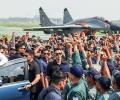
Modi's visit comes after days of intense conflict between India and Pakistan following Indian strikes in terror sites in the neighbouring country on May 7 under Operarion Sindoor.

India's Foreign Secretary Vikram Misri said on Thursday that the choice of de-escalation is with Pakistan, as India only responded to the April 22 Pahalgam terror attack, which killed 26 people. He added that Pakistan has been escalating the situation with cross-border terrorism against India for decades.

Escalating its tensions with India, Pakistan on Thursday targeted Jammu with loitering munitions and the Indian air defence guns are firing back. A complete blackout has been enforced in Jammu city.

Tahawwur Hussain Rana, a Pakistan-born Canadian national and close associate of David Coleman Headley, is set to be extradited to India from the US. Rana was involved in the planning and execution of the 2008 Mumbai terror attacks, which killed 166 people, including six Americans. He assisted Headley in obtaining a visa for India, established a front company in Mumbai, and helped in reconnaissance of targets in Mumbai and New Delhi. Rana was convicted in the US for providing material support to Lashkar-e-Taiba (LeT) and sentenced to 14 years in prison. His extradition to India will allow authorities to question him about his involvement in the Mumbai attacks and potentially uncover new information about the role of Pakistani state actors.

In a post on X, the additional directorate general of public information posted: "Pakistan again violates the Ceasefire Agreement by firing artillery in Bhimber Gali in the Poonch-Rajouri area. Indian Army is responding appropriately in a calibrated manner."

India on Sunday said it inflicted tremendous losses to the Pakistan military, including downing its fighter jets featuring latest technologies and damaging key military installations close to even capital Islamabad, during the three-day confrontation between the two sides.
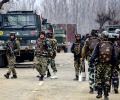
A police spokesman said based on specific input regarding the presence of terrorists in the Mirhama area of Kulgam in south Kashmir, a cordon and search operation was launched by the security forces there.
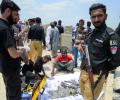
'This strike has certainly enhanced your image.' 'Otherwise, people would have called you a damp squib, capable of doing nothing except talking big.'
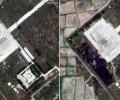
The attacks against the Pakistani air force have taken them at least five years back and caused great damage to them and their Chinese and Turkish inventory of weapons.
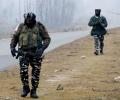
With the death of the three JeM terrorists in Anantnag, the number of terrorists killed in two gunfights, which broke out in South Kashmir on Wednesday night, has risen to six.

Sri Lankan police searched a flight arriving in Colombo from Chennai after receiving a tip that a suspect linked to the Pahalgam terror attack could be on board. The search was conducted in coordination with local authorities following an alert from the Chennai Area Control Centre. The aircraft was thoroughly inspected and cleared for further operations.

Pakistan's Olympics gold-winning javelin thrower Arshad Nadeem's Instagram account has been blocked in India owing to a "legal request" in the aftermath of the Pahalgam terror attack.
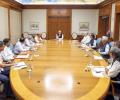
The Cabinet Committee on Security (CCS) met on Wednesday under the chairmanship of Prime Minister Narendra Modi and firmed up the responses to the terror attack.
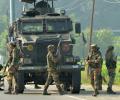
A huge cache of arms and ammunition, which includes an AK-47 rifle, magazines, grenades, RPG-7 rocket launcher, was recovered from the encounter site, he said.
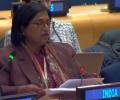
India has accused Pakistan of being a "rogue state" fueling global terrorism, following a confession by Pakistan's Defence Minister Khawaja Asif admitting to his country's history of supporting and funding terrorist organisations. India's Deputy Permanent Representative to the UN, Ambassador Yojna Patel, delivered a strong Right of Reply at a UN event, highlighting Asif's admission and condemning Pakistan's actions. Patel asserted that the world can no longer turn a blind eye to Pakistan's role in supporting terrorism.
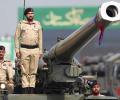
India has decided to submit a dossier at the upcoming Financial Action Task Force (FATF) meeting, calling for Pakistan to be placed back on the grey list of the global money laundering and terrorist financing watchdog.
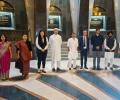
Terrorism is a global menace to be addressed by humanity in unison was the all-party delegation's message to Algeria as it concluded its visit to the North African country on Sunday.
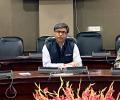
The sources said Misri reiterated the government's stand that the decision to stop military actions was taken at a bilateral level, as some opposition members questioned US President Donald Trump's repeated assertions about his administration's role in stopping the conflict.
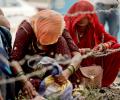
The Attari-Wagah border crossing point between India and Pakistan was shut completely on Thursday following a week-long heavy rush of people from either side to cross over after the Union government ordered all Pakistani citizens with short-term visa to leave India in the wake of the Pahalgam terror attack, sources said.

Pakistan's star javelin thrower Arshad Nadeem has refused to comment on his arch-rival Neeraj Chopra.
'Unlike the surgical strikes and the Balakot air strikes across the LoC, we have gone further inside Pakistan and raised the bar of escalation.'
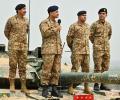
United States President Donald Trump will host Pakistan Army chief Asim Munir for lunch at the White House on Wednesday.

The Army chief is likely to visit Jammu and discuss the recent and ongoing counter-terrorist operations and the casualties that have been suffered in the recent terror attacks there, defence sources said.

India has accused Pakistan of violating the spirit of the Indus Waters Treaty by engaging in acts of terrorism and refusing to modify the treaty. India's Permanent Representative to the UN, Ambassador Parvathaneni Harish, addressed the UN Security Council, highlighting Pakistan's disinformation regarding the treaty and its continued support for cross-border terrorism. He stated that India has always acted responsibly as an upper riparian state and that Pakistan's actions have jeopardized civilian lives, religious harmony, and economic prosperity. India has suspended the treaty until Pakistan ends its support for terrorism.
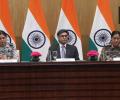
Colonel Sofiya Qureshi revealed that 300 to 400 drones were deployed across 36 locations, with several being shot down by Indian forces using both kinetic and non-kinetic methods.

India will argue for Pakistan's return to the Financial Action Task Force (FATF) grey list due to its alleged failure to combat money laundering and terror financing. The move comes after recent tensions between the two countries following a terror attack in Pahalgam, India. India believes Pakistan has not adequately addressed the issue of terrorism emanating from its territory and has diverted funds from multilateral agencies towards arms purchases.

It was "possibly a Pakistani fishing vessel", but the identity and other details will be ascertained once the boat is intercepted, the official said.
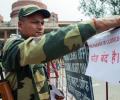
Chawdhary announced this after laying a wreath at the Amar Prahari memorial at the BS Headquarters in Jammu in remembrance of the fallen soldiers.
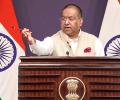
External affairs ministry spokesperson Randhir Jaiswal said India will keep the IWT in abeyance until Pakistan "credibly and irrevocably" abjures its support for cross-border terrorism.

Operation Sindoor is not just a name but India's latest policy against terror as it has set a new standard, a 'new normal' in counter-terrorism measures, Prime Minister Minister Narendra Modi asserted on Monday.
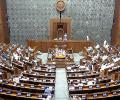
Congress general secretary in-charge communications Jairam Ramesh said that at a time when the BJP should be targeting Pakistan and terrorists, it is only interested in attacking the Congress.
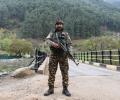
It is time we buried the mantra of 'peaceful and stable Pakistan is in our interest'. It is not, simply because Pakistan's existence -- that is synonymous with its army -- means peace has no chance, asserts Colonel Anil A Athale (Retd). It is time we buried the mantra of 'peaceful and stable Pakistan is in our interest' asserts Colonel Anil A Athale (Retd).

'If they aim to remain aligned with the public sentiment, as any democratic government should, then they must respond. Why else would the prime minister have cut short his visit to Saudi Arabia? And why would he have instructed the home minister himself to travel to Srinagar to assess the situation firsthand? This suggests that something is indeed being planned. I am quite certain of that, although the exact form it will take remains to be seen.'
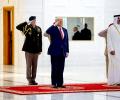
'He is intrigued by the intractability of Kashmir issue. With his interest in dealmaking and peacebrokering, he sees it as an exciting challenge to tackle.'
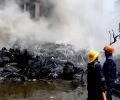
Why not stream all the data in real time to multiple recipients? It would make the investigation of aviation incidents much easier and far more transparent, recommends Devangshu Datta.

The Indian government has revoked 14 categories of visas for Pakistani nationals, including business, conference, visitor, and pilgrim visas, following the terror attack in Pahalgam, Jammu and Kashmir. The decision was made after a Cabinet Committee on Security meeting, and the Home Minister has instructed state governments to ensure that all Pakistani nationals leave India by the set deadlines. The order does not apply to Long Term Visas (LTVs) and diplomatic and official visas issued to Pakistani nationals.
